

The energy transition is accelerating rapidly, reshaping how electricity is generated, stored, and delivered. For the Philippines, 2025 marked a pivotal year as the country intensified its efforts to decarbonize the power sector. As the grid becomes increasingly renewable and more digital, the industry is entering an era defined by flexibility, resilience, and smarter system planning. From policy reform to cyber readiness and the rise of hybrid systems, 2026 is set to build on this momentum and challenge developers, technology providers, and operators to elevate both technical performance and social responsibility. Below are seven trends we expect to define the year ahead in the Philippines.
1. The drive toward renewables in the Philippines will create an increased need for both short- and long-duration battery energy storage systems (BESS)
The International Energy Agency (IEA) reports that the Philippines remains heavily dependent on coal, which supplied around 62% of the country’s power in 2024. However, recent policy shifts and growing investment in renewables signal a turning point for the national energy mix. Short-duration BESS will remain essential for frequency control, congestion management, and ancillary services. However, as coal retires and weather-driven variability grows, the need for long-duration energy storage (LDES) will become more prominent. Longer-duration assets can sustain the Philippines’ grid during low-renewables periods, mitigate prolonged outages, and significantly enhance grid resilience.
2. Policy reforms, with energy storage as a critical tool to facilitate the expansion of renewable assets
Policy reforms will continue to reshape the Philippines’ energy landscape in 2026, as the government tackles high electricity tariffs, among the steepest in Southeast Asia, by dismantling structural barriers and driving renewable investment.
Since the launch of the Green Energy Option Program (GEOP) in 2021, corporate demand for clean power has surged, allowing consumers to source electricity directly from renewable suppliers. Yet supply has lagged, exposing a critical bottleneck in generation capacity and prompting policymakers to accelerate solutions.
The Green Energy Auction (GEA) has emerged as a key mechanism to close this gap, delivering transparent pricing and boosting investor confidence. Recent auction rounds have prioritized storage integration and diversified technologies: GEA-3 spotlighted pumped hydro, GEA-4 introduced the first solar-plus-battery auction for 1.1 GW, and GEA-5 targeted 3.3 GW of offshore wind for 2028–2030. These innovations are already taking shape, as battery systems are enabling solar to operate beyond daylight hours, signaling a future where renewables can serve as reliable baseload power.
3. Cybersecurity will become a core pillar of project development
As power systems in the Philippines digitalize, cyber resilience is fast becoming not just best practice, but a regulatory and national security imperative. Grid-connected assets, from substations to transmission infrastructure, now sit at the intersection of critical infrastructure and sophisticated cyber threats. What used to be manually operated, physically isolated systems are now interconnected, software-controlled, and reliant on real-time data and remote operations. This digital transformation delivers real benefits: faster response times, improved system management, and better integration of new technologies – vital for a rapidly evolving energy landscape.
However, with those gains come new vulnerabilities. The shift elevates electricity networks in the Philippines to prime targets for cyberattacks, with potential consequences extending beyond individual utilities. This includes widespread blackouts, disruption of essential services, and national security risks. In 2025, the Department of Energy (DOE) formalized this reality by issuing Department Circular No. DC2025-01-0001: “Institutionalizing the Energy Sector Cybersecurity and Cyber Resilience Framework.” This directive indicates that the energy sector must now embed cybersecurity throughout planning, operations, and maintenance.
Looking ahead to 2026, we expect developers, grid operators, and energy stakeholders to place greater emphasis on understanding hardware and software exposures, adopting international cyber standards, and defining clear divisions of responsibility across the asset lifecycle. Cyber readiness will increasingly be scrutinized by regulators, investors, and insurers alike.
4. The need for secure and resilient power systems is more important than ever
Large-scale outages across the globe have highlighted how vulnerable modern power systems can be and how deeply society depends on reliable electricity. As grids expand and age, and as traditional synchronous generators make up a smaller share of the fleet, pressures on system performance are increasing. Congestion, stability risks, and reliability challenges are becoming more visible. The IEA’s Electricity Mid-Year Update 2025 points to a clear solution pathway: stronger and more modern infrastructure, resilient supply chains, a broader suite of flexible resources, and new technologies that can support system stability.
To keep pace with these shifts, the frameworks that guide system operation must evolve as well. Grid codes, reserve standards, and regulatory mechanisms all need to be updated, so the electricity system remains secure, adaptable, and capable of supporting higher shares of renewable generation.
We also anticipate the National Grid Corporation of the Philippines (NGCP) advancing its initiative to own and operate energy storage systems as part of its broader strategy to enhance the Philippines’ grid reliability. By integrating advanced BESS technologies into the transmission network, NGCP will be better positioned to strengthen grid stability, support system resilience, and ensure the continuous, high-quality delivery of electricity nationwide.
5. Grid-forming projects will define the next wave of deployment
Grid-forming BESS is becoming a global priority, and the Philippines is moving in the same direction as renewable penetration rises and the grid becomes more dependent on inverter-based resources. Many countries and regulators are now issuing new guidance that either requires or financially incentivizes grid-forming capabilities for new large-scale storage assets.
The drivers behind this trend are highly relevant for the Philippines. Traditional synchronous generators, long relied upon for inertia, voltage support, and fault current, are gradually retiring, while replacement stability resources are being deployed. At the same time, the Philippines’ growing fleet of solar and wind projects, combined with the archipelago’s dispersed and weather-exposed grid, increases the importance of maintaining strong system stability. Grid-forming BESS is emerging as a practical way to fill this gap by replicating the stabilizing behavior of synchronous machines and supporting higher levels of inverter-based renewables to connect safely and efficiently.
6. Hybrid renewables + storage projects will continue to rise
Hybrid renewables-plus-storage projects are rapidly shifting from concept to reality, particularly in the Philippines, where hybrid BESS can tackle a growing problem: the curtailment of energy from renewable assets. Developers are increasingly developing solar, wind, and battery assets behind a single point of interconnection to boost renewable generation, reduce curtailment, and improve project economics.
Regulatory frameworks are adapting to this shift. The Philippines GEA is driving particular interest in hybrid energy storage systems, combining renewable generation, such as wind or solar, with battery storage, operating together behind a single grid connection point.
Hybrid architectures are evolving in parallel. DC-coupled systems are gaining traction in markets where capturing clipped energy and optimizing interconnection costs is valuable. In the Philippines, AC-coupled systems will be the most cost-effective solution to optimize the hybrid power plant dispatch based on forecasts to maximize revenue and meet out-of-the-box compliance with local grid codes and requirements, including market-specific applications.
As uptake grows worldwide, hybrid power plant control is shifting toward more sophisticated, software-led approaches. Grid operators are raising expectations for these sites, requiring consistent performance, rapid response, and the ability to support advanced grid services. The next stage of development will hinge not just on adding more hybrid capacity, but on how seamlessly these assets operate within actual grid conditions.
7. Data centers will rapidly reshape demand patterns and storage opportunities
Data centers are becoming one of the fastest-growing sources of electricity demand worldwide, driven by the expansion of AI, hyperscale cloud services, and high-performance computing. The Philippines is seeing this shift firsthand as major operators accelerate investment in new campuses across Luzon and emerging regional hubs. This growth places new pressure on an already constrained grid and increases the need for clean, reliable backup solutions that move beyond traditional diesel generation.
As operators work to cut emissions and improve operational resilience, battery energy storage systems (BESS) are expected to gain traction as a solution. Energy storage has the potential to provide instant backup power, complement or replace conventional UPS systems and diesel generators, reduce peak demand charges, and support grid-related services.
On larger campuses, BESS also provides black start capability and boosts resilience with rapid, flexible response during system disruptions, offering a seamless way to integrate with diverse on-site generation sources. As data center demand grows, storage will play a vital role in ensuring both campus resilience and broader grid stability in the Philippines.
Looking ahead
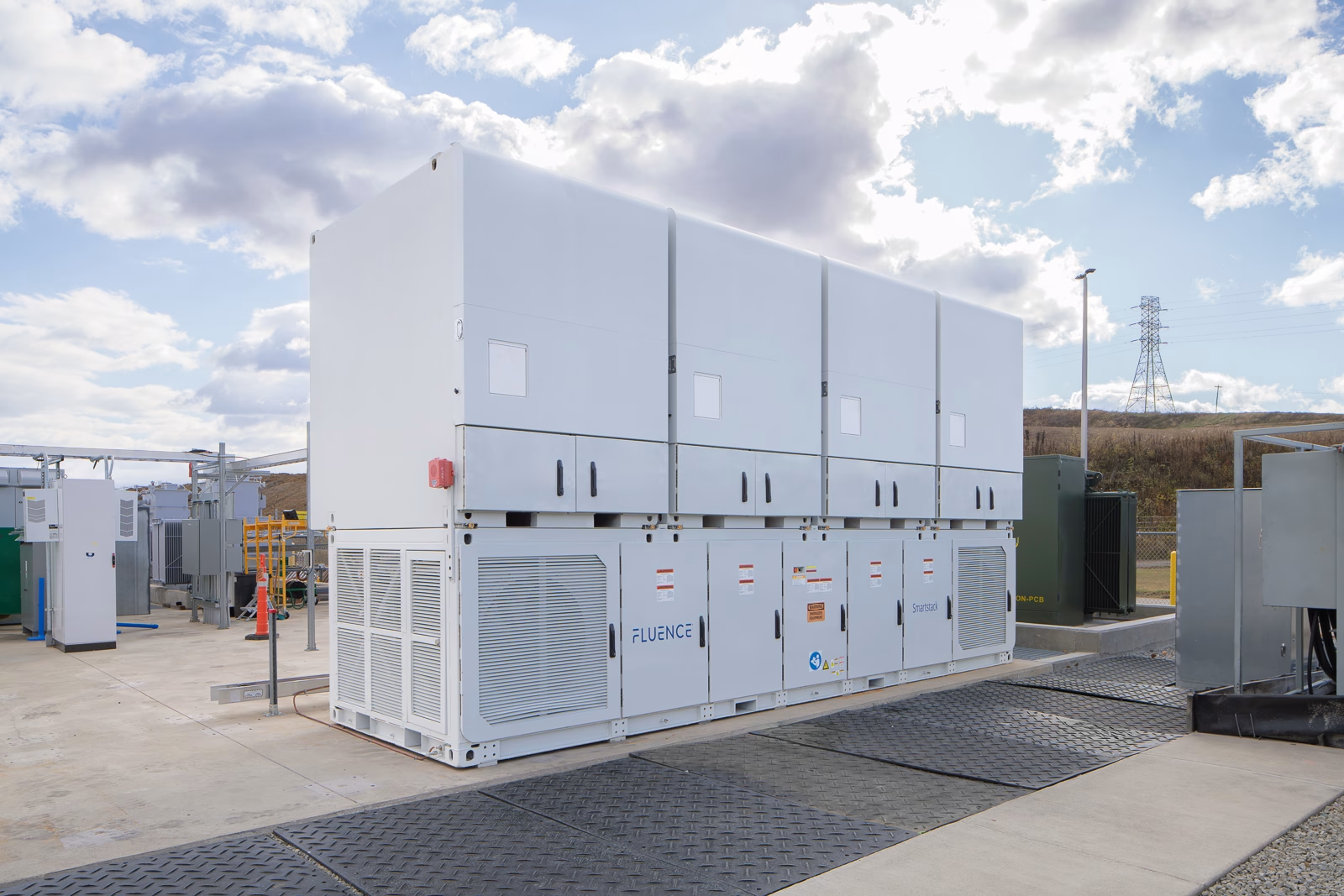
2026 will reward developers, operators, and policymakers who understand that power system security and resilience are just as critical to the energy transition as the size of the storage system. BESS will continue to play a pivotal role, but success will increasingly rely on resilience, policy reforms, and cybersecurity. As the industry matures, the focus is shifting toward solutions that are smarter, more adaptable, and capable of supporting increasingly complex grids, such as Fluence’s Smartstack™.

Gabriel
Introvert, wanderer, blogger, foodie, a hip-hop music writer, and one of the co-founders of a tech start-up company called GigsManila.
Related Articles
More by category, author, or tags


